Last updated:
Looking for tooth extraction near Claremont? Renov Dental Group, on N Indian Hill Blvd just north of the Claremont Village, provides gentle removal of teeth that cannot be saved — with a clear plan for what comes next. Care is led by UCLA-trained Dr. Sally Yi, DDS, the office accepts most major PPO insurance plans, and it is known for genuinely gentle care for anxious patients.
Extraction is always our last resort. Dr. Yi's conservative philosophy means we first explore every realistic way to save a tooth — and when removal truly is the right choice, we focus on a gentle experience and on planning the replacement before the tooth ever comes out.
A tooth extraction is the careful removal of a tooth that can no longer be predictably saved — typically because of deep decay, fracture, advanced gum disease, infection, or crowding. A simple extraction works by numbing the area completely, then gently loosening the tooth within its socket using controlled, gradual pressure until it releases — modern technique relies on patience and leverage, not force. When a tooth is broken or firmly anchored, a minor surgical approach sections it for smoother removal.
Extraction fits when a tooth's root, bone support, or crown is damaged beyond what a filling, crown, or root canal can predictably repair: decay or fracture well below the gumline, advanced gum disease with significant bone loss, a failed root canal that can't be retreated, or severe crowding. Extraction is generally not recommended, and we will say so, when a tooth is restorable — a saved natural tooth almost always outperforms a replacement over the long run. Certain conditions (uncontrolled diabetes, blood-clotting disorders, recent jaw radiation, some bone-strengthening medications) can affect healing and planning, so share your full medical history and current medications before treatment.
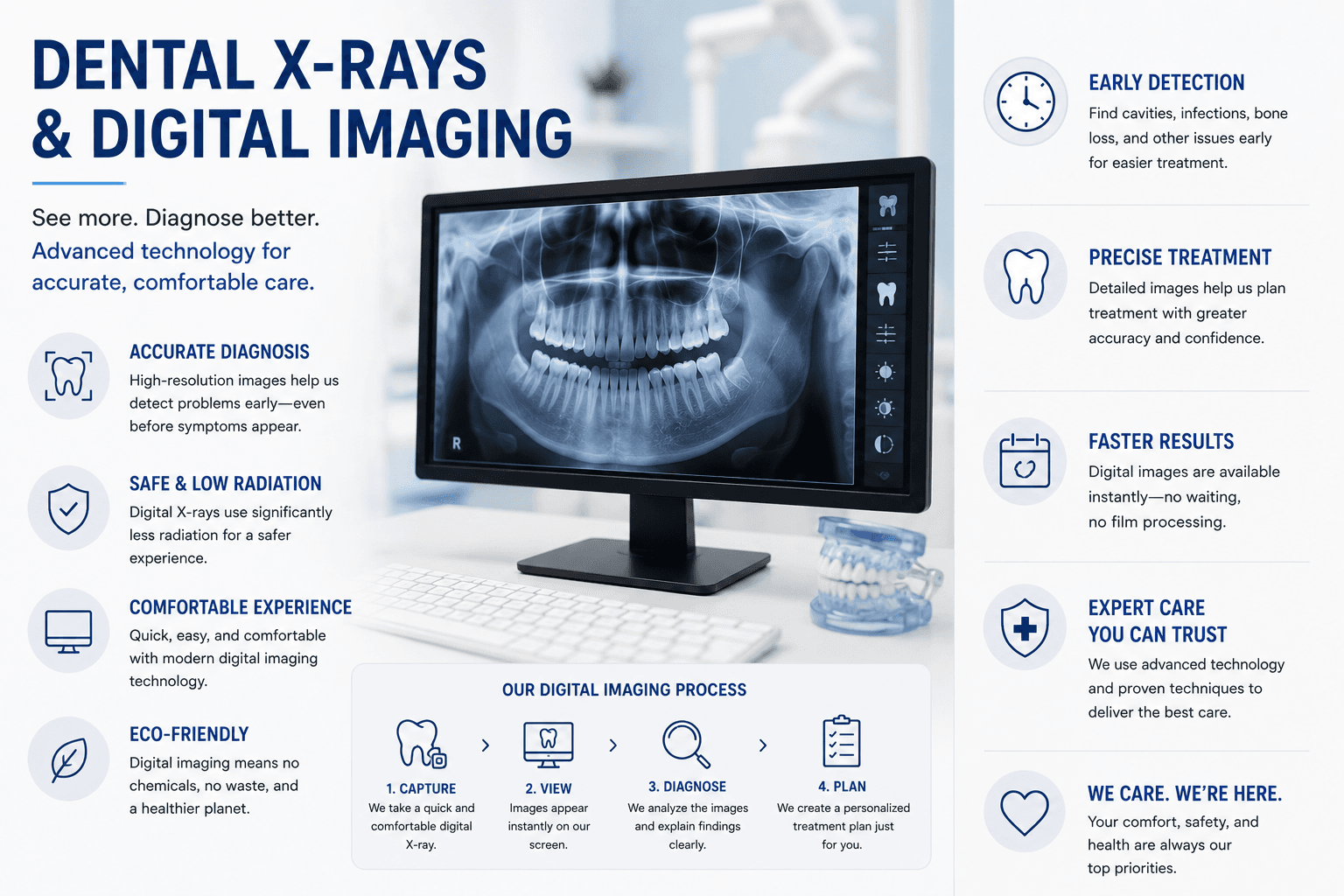
X-rays and a careful exam
confirm extraction is truly necessary.
We discuss replacement options first
— so there is a plan beyond the extraction.
Profound numbing
verified before we begin.
Gentle, controlled removal
— you feel pressure, not pain.
Clear written aftercare
and a follow-up plan for healing and replacement.
Bite gently on gauze for the first 30–60 minutes to form a stable blood clot — protecting that clot is the key to healing. Avoid straws, smoking, and vigorous rinsing or spitting for 48–72 hours (longer for smoking, ideally a full week, since it's a leading cause of delayed healing). Stick to soft foods for a few days and use a cold compress the first day. Most patients return to normal routines within 1–2 days, with soreness usually managed well by over-the-counter pain relief.
Extraction is routine and well understood, but every surgical procedure carries some risk:
Healing speed varies by patient and no outcome is guaranteed. Call us if pain worsens after day three instead of improving, or if you notice fever, pus, or persistent bleeding.
Because extraction is irreversible, we evaluate whether a tooth can realistically be saved first — root canal treatment to remove infected nerve tissue, a crown to reinforce a cracked tooth, or periodontal treatment to stabilize a tooth loosened by gum disease. Extraction is recommended only when these options are unlikely to succeed or hold up long-term.
The extraction itself is completed in a single visit. Gum tissue typically closes over 1–2 weeks, and bone matures over several months; implant or bridge planning can begin as soon as healing allows — sometimes immediately with socket preservation. Cost depends on the extraction type (simple vs. surgical), whether socket preservation is added, and your insurance benefits; we provide a written estimate before any treatment. Don't leave a missing back tooth unaddressed long-term — neighboring teeth drift and bite changes follow, so it's worth discussing replacement timing early.
Most major PPO plans are accepted, including Delta Dental, Aetna, Cigna, MetLife, Anthem Blue Cross, Blue Shield of California, and more. Extractions are a standard covered service on most PPO plans; surgical extractions are categorized separately by insurers. We verify your specific benefits before treatment and explain estimated coverage in writing. Patients without insurance are welcome, and Cherry monthly financing is available for qualified patients.
A. Removing a hopeless tooth ends the pain and infection at its source, protects neighboring teeth and bone from further damage, and clears the way for a healthy replacement such as an implant or bridge.
A. After complete numbing, the tooth is gradually loosened with gentle, controlled instruments until it releases; broken teeth may be sectioned first so removal stays smooth and predictable.
A. You should feel pressure but not pain — we always verify the area is profoundly numb first. Most simple extractions aft
Call (909) 625-4900 or book an appointment online to talk through your options for tooth extraction.