Wisdom Teeth Removal
Last updated:
Need wisdom teeth removal near Claremont? Renov Dental Group, on N Indian Hill Blvd just north of the Claremont Village, provides careful evaluation and gentle removal of problem wisdom teeth — with honest advice when removal isn't needed. Care is led by UCLA-trained Dr. Sally Yi, DDS, the office accepts most major PPO plans, and it is known for genuinely gentle care for anxious patients. Not every wisdom tooth needs to go, and Dr. Yi's hospital-residency surgical training and gentle pacing make removal, when it is the right call, far calmer than its reputation.
What Is Wisdom Teeth Removal?
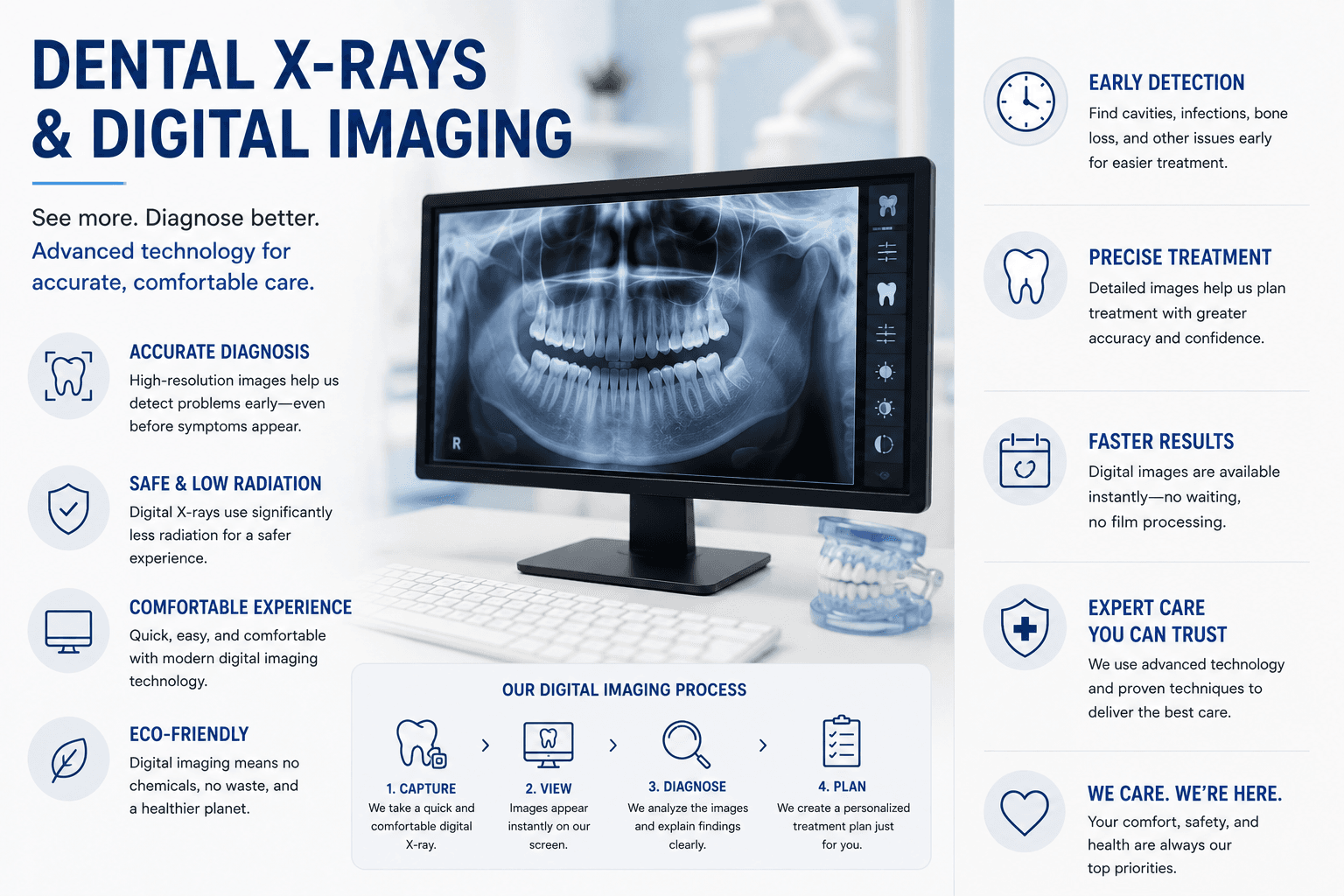
Wisdom teeth removal is the extraction of the third molars — the last teeth to erupt, typically in the late teens and early twenties — when they are impacted, infected, causing crowding, or threatening neighboring teeth. An erupted wisdom tooth comes out much like any extraction; an impacted one, angled or trapped beneath gum and bone, is exposed through a small gum opening and often sectioned into pieces so each lifts out gently with minimal disturbance to surrounding bone. X-ray (and when needed, 3D/CBCT) imaging maps nerves and roots beforehand, which helps reduce the risk of nerve injury.
Am I a Candidate? (And When Watchful Waiting Is Reasonable)
Removal is generally recommended for wisdom teeth that are:
- Causing pain or pressure at the back of the jaw
- Partially erupted with recurring gum infection around them (pericoronitis)
- Decayed beyond predictable repair, or damaging the neighboring second molar
- Impacted at an angle that X-rays show is unlikely to resolve on its own
- Associated with a cyst, or contributing to crowding as part of orthodontic planning
Removal isn't automatically necessary for every wisdom tooth — a fully erupted, well-positioned, symptom-free tooth you can clean effectively may reasonably be monitored with periodic X-rays instead. Timing matters, too: removal tends to be technically easier and recovery quicker in the late teens and early twenties, when roots aren't yet fully formed and surrounding bone is less dense.
Common Wisdom Teeth Removal Options at Our Office
- Erupted Wisdom Tooth Extraction — for teeth fully through the gum, similar to a routine extraction.
- Impacted Wisdom Tooth Removal — a minor surgical procedure exposing and sectioning the trapped tooth.
- Evaluation and Monitoring — X-ray-based assessment when the right plan is simply watching.
What to Expect, Step by Step
- 1.
Panoramic X-ray
maps the teeth, roots and nearby nerve positions.
- 2.
An honest recommendation
— including "this one can stay" when true.
- 3.
Profound anesthesia
, with comfort options discussed in advance for anxious patients.
- 4.
Gentle, methodical removal
— sectioning when it makes the surgery smaller, not bigger.
- 5.
Written aftercare
, and a follow-up check on your healing.
Recovery and Aftercare
Plan to rest the day of surgery; most patients resume light routine in 2–3 days. Swelling peaks around day two — cold compresses the first day help significantly. Stick to soft foods for several days, and avoid straws, smoking, and vigorous rinsing or spitting, which can dislodge the healing clot and lead to dry socket. We give written warning signs (pain that worsens instead of improves, starting a few days after surgery) so you know when to call.
The procedure commonly takes 30–60 minutes depending on how many teeth and their position. Initial gum healing takes about 1–2 weeks, with full bone fill-in continuing over a few months.
Risks & Limitations
Wisdom tooth removal is common and generally safe, but as with any surgery, complications are possible:
- Dry socket is more common after lower wisdom tooth removal than after routine extractions; avoiding smoking, straws, and forceful spitting is the main prevention.
- Nerve involvement is a recognized risk for lower wisdom teeth, whose roots can sit close to the nerve supplying feeling to the lip, chin, and tongue — temporary numbness is uncommon and permanent numbness is rare; imaging beforehand helps us assess and minimize this risk.
- Sinus involvement is a possible, uncommon risk with upper wisdom teeth, whose roots can sit near the sinus floor.
- Infection, bleeding, or delayed healing, more likely with smoking or pre-existing gum disease.
We discuss your individual risk profile, based on X-ray findings, at your consultation before scheduling surgery.
Alternatives to Removal
If a wisdom tooth is symptom-free, fully erupted, and cleanable, monitoring with regular exams and X-rays is a reasonable alternative. For teeth with mild early symptoms, improved cleaning or treating a localized gum infection can help temporarily, though it usually doesn't resolve an underlying impaction long-term. We'll tell you clearly which category your case falls into.
Timeline and Cost Factors
A single-visit surgery date is scheduled once imaging and planning are complete. Cost depends on how many teeth are removed, whether they are erupted or impacted, and your insurance benefits — we verify coverage and provide a written estimate before scheduling surgery.
After You Have Healed
- Keep the back corners clean — the area behind the second molars still collects plaque.
- Routine checkups confirm the extraction sites matured normally.
- If only some wisdom teeth were removed, the others stay under periodic X-ray review.
Treatments That Pair Well With Wisdom Teeth Removal
- Sedation & Anxiety-Friendly Dentistry — comfort options discussed at your consultation.
- Tooth Extraction — the same gentle removal principles for other teeth.
- Emergency Dentistry — for sudden wisdom tooth pain or swelling that can't wait.
- Root Canal Treatment — considered when a nearby second molar is affected.
Why Claremont-Area Patients Choose Renov Dental Group
- A gentle, patient-first approach for people who feel nervous about dental visits
- Care led by Dr. Sally Yi, DDS — UCLA-trained, Dean's Scholarship, named Resident of the Year during her hospital residency
- A conservative philosophy: preserving natural teeth whenever possible, recommending only what is needed
- Most major PPO plans accepted, with flexible monthly financing through Cherry
- A convenient office on N Indian Hill Blvd, close to the I-10 and 210 freeways
Insurance & Financing
Most major PPO plans are accepted, including Delta Dental, Aetna, Cigna, MetLife, Anthem Blue Cross, Blue Shield of California, and more. Wisdom tooth extraction is covered as a surgical extraction by most PPO plans, with impacted classifications priced separately by insurers; we verify your exact benefit and put the estimate in writing. Patients without insurance are welcome, and Cherry monthly financing is available for qualified patients.
FAQ
Do all wisdom teeth need to be removed?+
Not necessarily. Some erupt fully, sit in a good position, and can be cleaned effectively — an X-ray-based evaluation determines whether yours can be monitored instead of removed.
What does wisdom teeth removal actually do for you?+
Removing problem wisdom teeth ends the cycle of pain and recurring infection at the back of the jaw, and protects the healthy second molars in front of them from decay and damage.
How is wisdom teeth removal performed at Renov Dental Group?+
Guided by panoramic imaging, the tooth i
Schedule a Consultation
Call (909) 625-4900 or book an appointment online to find out whether your wisdom teeth need to come out.