Root Canal Treatment in Claremont, CA
Last updated:
Looking for root canal treatment near Claremont? Renov Dental Group, on N Indian Hill Blvd just north of the Claremont Village, provides modern, comfortable root canal therapy that ends severe tooth pain and saves the tooth. Care is led by UCLA-trained Dr. Sally Yi, DDS, and the office accepts most major PPO plans.
Few procedures carry more outdated fear than this one. Per the American Association of Endodontists, the discomfort people associate with root canals comes from the infection; the treatment ends it, and most patients find it no more uncomfortable than a filling. At Renov Dental Group, root canals are quiet, thoroughly numbed appointments that reflect our conservative philosophy: keeping your natural tooth whenever realistically possible.
What Is Root Canal Treatment?
Root canal treatment removes infected or dying nerve tissue from inside a tooth, disinfects the canals, and seals them — saving a tooth that would otherwise need extraction. After profound anesthesia, a small opening is made, the infected pulp is removed, the canals are cleaned and shaped, then filled and sealed so bacteria cannot return. A crown usually follows to protect the now-hollow, more brittle tooth. Root canals are most often needed when deep decay or a crack lets bacteria reach the nerve.
Signs You May Need a Root Canal
- Severe toothache, especially throbbing or spontaneous pain
- Pain that lingers long after hot or cold exposure
- Pain when biting or pressing on one specific tooth
- A pimple-like bump (fistula) on the gum near a tooth
- A tooth darkening compared with its neighbors
- Swelling or tenderness around the tooth
Am I a Candidate for a Root Canal?
Most teeth with an infected or inflamed nerve can be treated and saved — preserving a natural tooth maintains chewing function, jawbone health, and alignment. An exam and X-rays confirm candidacy. Occasionally a tooth is not a good candidate: a fracture below the gumline, too little healthy structure to crown, advanced bone loss, or canals too narrow or curved to clean reliably. In these cases, extraction and replacement is usually more predictable, and we'll tell you honestly if it applies to you.
Root Canal Options at Our Office
- Anterior Root Canal — front teeth, typically the quickest cases.
- Premolar and Molar Root Canals — back teeth with multiple curved canals, treated with magnification.
- Root Canal Retreatment — re-treating a tooth whose prior root canal has become reinfected.
What to Expect, Step by Step
- 1.
Diagnosis
pinpoints the offending tooth with testing and X-rays.
- 2.
Profound numbing
— verified before anything begins.
- 3.
Removal of infected pulp
then cleaning and disinfecting the canals.
- 4.
Sealing
the canals with biocompatible filling material.
- 5.
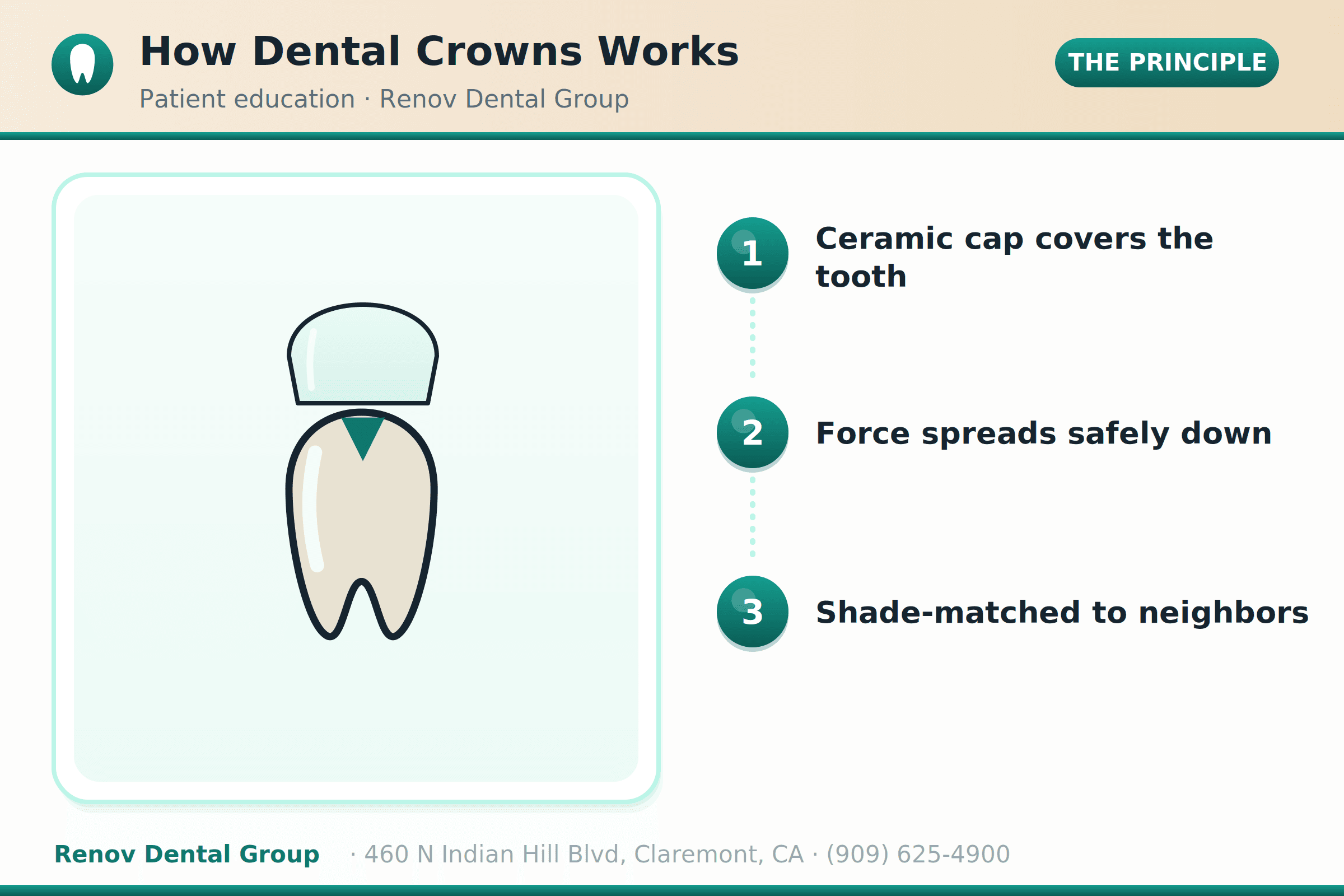
A protective crown is planned
to restore full chewing strength.
Recovery and Timeline
Mild soreness when chewing for a few days is normal, managed well with over-the-counter pain relievers; the severe pre-treatment pain is usually gone quickly. Avoid hard foods on the tooth until its crown is placed, then brush and floss it like any other tooth. Many root canals complete in a single 60–90 minute visit; complex teeth may need a second visit, plus two shorter crown visits after. Cost and timeline depend on which tooth is involved, whether it's a retreatment, and whether a buildup is needed — we provide a written estimate first.
Seek prompt or emergency care for significant facial swelling, fever, or difficulty swallowing or breathing — signs of a spreading infection.
Risks & Limitations
Root canal treatment is well-established and predictable, but results are not guaranteed. Symptoms or infection can occasionally persist or return, and the tooth may then need retreatment, an apicoectomy, or, less commonly, extraction. A treated tooth is also more brittle, so a crown is strongly recommended soon after. With prompt crown placement and routine care, most root-canaled teeth function for many years.
Alternatives to Root Canal Treatment
The main alternative is extraction, replacing the tooth with a dental implant, a bridge (Crowns & Bridges), or a partial denture. Since a natural root helps preserve jawbone, root canal treatment is usually recommended first when a tooth is realistically savable. An infected tooth won't heal on its own, so waiting is not safe — see Tooth Extraction if removal is right for you.
Treatments That Pair Well With Root Canal Treatment
- Crowns & Bridges — a protective crown typically follows root canal treatment.
- Sedation Dentistry — comfort options for nervous patients.
- Dental Implants — considered when a tooth cannot be saved.
Why Claremont-Area Patients Choose Renov Dental Group
- A gentle, patient-first approach for people who feel nervous about dental visits
- Care led by Dr. Sally Yi, DDS — a UCLA-trained dentist who received the Dean's Scholarship and was named Resident of the Year during her residency
- A conservative philosophy: preserving natural teeth whenever possible
- Most major PPO plans accepted, with monthly financing through Cherry
- A convenient office on N Indian Hill Blvd, near the I-10 and 210 freeways
FAQ
Q. Is root canal treatment painful?+
A. A modern root canal feels similar to a long filling. The notorious pain belongs to the infection beforehand; the procedure ends it. Comfort support can be planned for anxious patients.
Q. How long does root canal treatment take?+
A. Most cases finish in a single 60–90 minute visit; complicated molars occasionally need a second visit, plus crown appointments after.
Q. Can every tooth be saved with a root canal?+
A. Most can, but not all. A fracture below the gumline, too little remaining structure, advanced bone loss, or unreliable canal anatomy may make extraction and replacement the better path.
Q. What happens if I don't treat an infected tooth?+
A. It won't resolve on its own; pain typically worsens and infection can spread, sometimes becoming an emergency. Prompt treatment is safer than waiting.
Q. Will I need a crown after my root canal?+
A. Usually, yes — the treated tooth is more brittle, and a crown protects it from fracture.
Q. Does my dental insurance cover root canal treatment?+
A. Root canal therapy is typically covered under most PPO plans at a percentage depending on your benefits; we confirm and provide a written estimate first. Cherry monthly financing is available for qualified patients.
Schedule a Consultation
Call (909) 625-4900 or book an appointment online if you have tooth pain or think you may need a root canal.